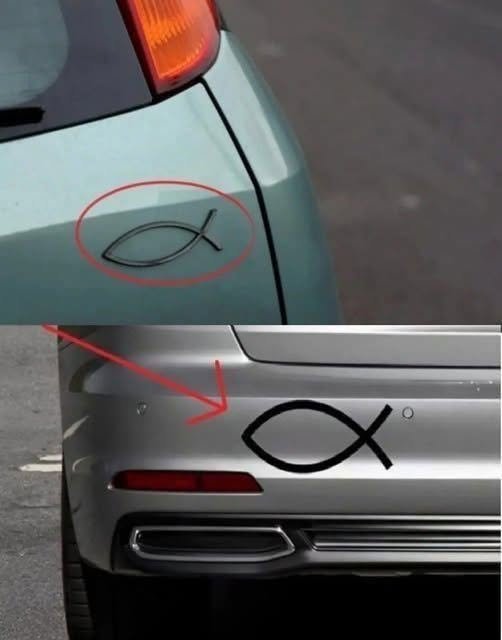
You’ve probably seen it hundreds of times: a small silver fish attached to the trunk or bumper of a car. No words, no complicated design, just two curved lines forming a fish.
Most people assume it’s simply a decorative sticker or perhaps the logo of an unfamiliar car company. But its meaning goes back nearly 2,000 years.
In fact, this tiny emblem has connections to early Christianity and a fascinating history that existed long before automobiles were invented.
And once you understand what those simple lines represent, you may never look at that little fish on someone’s bumper quite the same way again.
The symbol is known as the Ichthys, an ancient Christian emblem that represents faith in Jesus Christ. Its distinctive outline is created using two intersecting arcs, forming the simple shape of a fish.
Its name comes from the Greek word for fish, but there’s another interesting detail hidden within those letters.
Early Christians associated the five Greek letters of ICHTHYS with a phrase meaning “Jesus Christ, Son of God, Savior.” In other words, a single familiar shape could express an entire statement of religious belief.
The fish also connects to several important biblical stories, including Jesus feeding thousands of people with loaves and fishes and calling his disciples to become fishers of men.
During Christianity’s early centuries, believers used the fish in religious artwork, inscriptions, and burial sites. Its simple appearance made it an easily recognizable symbol of their shared faith.
A popular tradition even describes early Christians drawing the fish to discreetly identify fellow believers during periods of persecution, although historians cannot confirm how widely this particular practice occurred.
So how did an ancient religious symbol eventually find its way onto modern car bumpers?
The emblem experienced a revival during the twentieth century, particularly among Christian communities seeking a simple, recognizable way to express their beliefs.
Today, drivers display it for different personal reasons. Some use it as a public declaration of their Christian faith, while others appreciate its associations with hope, compassion, and spiritual belonging.
You might also notice versions containing the word JESUS or the original Greek letters. These variations generally communicate the same central religious message.
Interestingly, the familiar design has inspired several modern adaptations, including the Darwin fish, which features small legs and is commonly associated with evolution.
However, the traditional outline without additional markings remains widely recognized as a Christian symbol.
For many people, placing it on a vehicle is simply another way of expressing something important to them, much like wearing a religious necklace or displaying a meaningful symbol at home.
It doesn’t automatically reveal anything about the driver’s personality, behavior, or driving habits. Its primary meaning is religious rather than automotive.
So the next time you’re waiting at a traffic light and notice that tiny silver fish on the vehicle ahead, remember that you’re looking at something much older than the car carrying it.
What appears to be an ordinary bumper decoration actually represents a tradition that has survived for nearly two millennia, connecting a modern driver to one of Christianity’s earliest and most recognizable symbols.